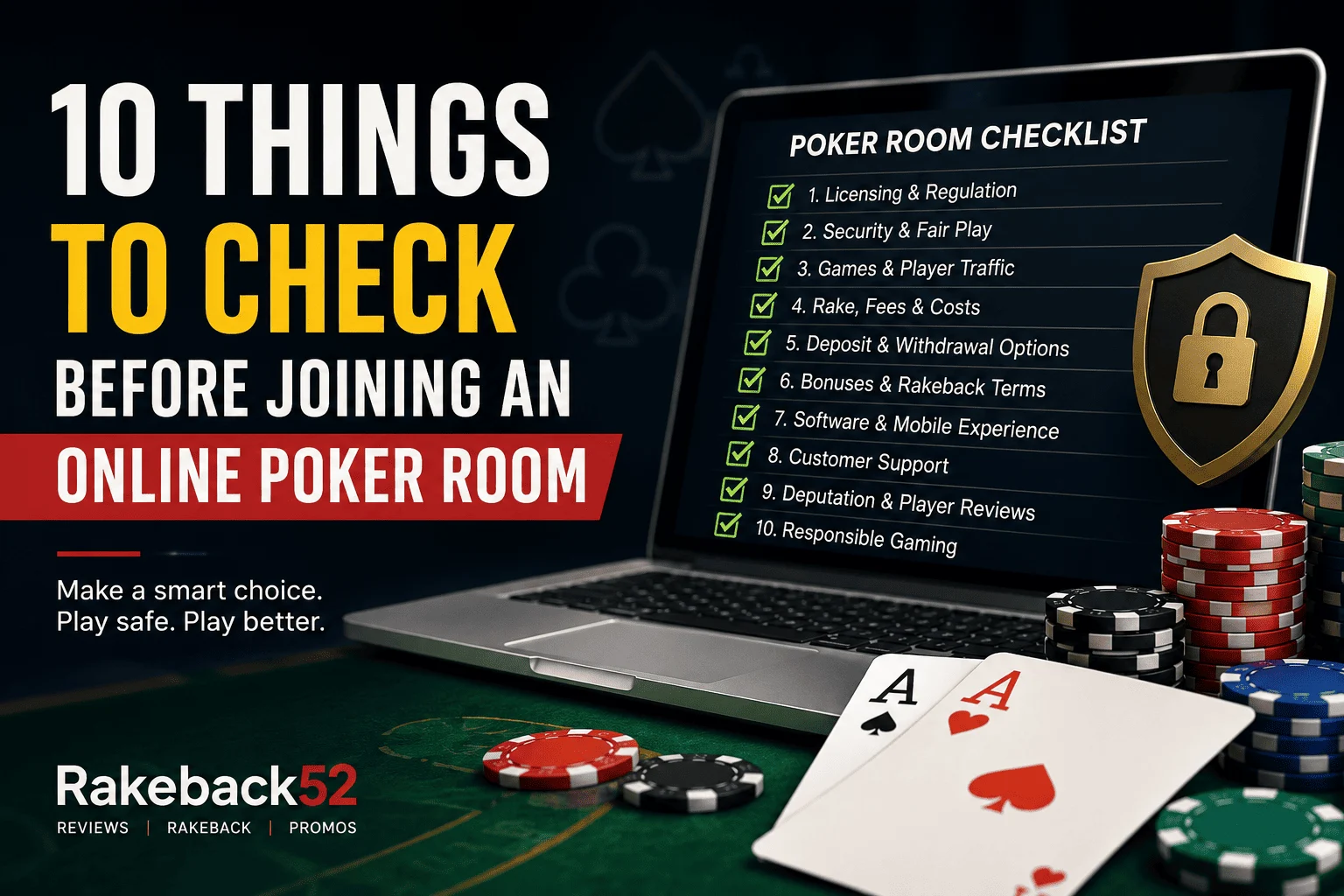
Choosing an online poker room should never be based only on the size of its welcome bonus, the number of games available, or how attractive its promotional campaigns appear. A reliable poker platform should provide a combination of player security, fair game mechanics, transparent terms, convenient payment methods, responsible gaming controls, and dependable customer support. These factors become especially important when you plan to deposit real money and play regularly.
The online poker industry includes established operators, smaller regional platforms, independent poker networks, and newer brands competing for players. While this creates plenty of choice, it also means players need to evaluate a platform carefully before creating an account or making a deposit.
A proper evaluation can help you identify whether a poker room is trustworthy, whether its games are appropriately regulated, whether withdrawals are practical, and whether its promotional terms are genuinely valuable. Rakeback52 can also help players research poker platforms, compare available offers, and understand the differences between poker rooms before deciding where to play.
Here are 10 important things to check before joining an online poker room.
1. Check the Poker Room's Licensing and Regulatory Status
The first and most important step is determining whether the poker room operates under a legitimate licence or regulatory framework. A licence provides a level of oversight concerning areas such as player funds, game integrity, responsible gambling, anti-money-laundering procedures, and operator conduct.
A legitimate poker operator should clearly identify the company responsible for running the platform, its registered jurisdiction, and, where applicable, the regulatory authority overseeing its operations. This information is generally available in the website footer, terms and conditions, responsible gaming section, or legal information page.
Do not assume that a licence badge displayed on a website automatically proves that an operator is legitimate. A player should verify the licence details independently whenever possible. Look for the legal company name, licence number, jurisdiction, and regulator.
Why licensing matters for real-money poker players
Regulation can provide important protections when money is involved. Depending on the jurisdiction, licensed operators may be required to maintain procedures for handling customer funds, identity verification, complaints, responsible gambling, and suspicious transactions.
It is also important to check whether the operator is actually authorised to accept players from your country or region. A poker room may be licensed somewhere but still be unavailable or restricted in particular jurisdictions.
Before registering, check:
The operator's legal company name
The licensing jurisdiction
Licence or registration details
Countries and regions accepted by the platform
Responsible gambling policies
Dispute and complaint procedures
Terms governing player accounts and funds
A poker room that makes its legal and regulatory information difficult to find should be approached cautiously.
2. Examine the Security Technology Used to Protect Your Account
Account security is another critical consideration because an online poker account can contain personal information, financial details, transaction records, and real-money balances.
A professional poker platform should use appropriate security technologies to protect communication between your device and its servers. HTTPS encryption should be enabled across account-related pages, particularly during login, registration, deposits, and withdrawals.
Players should also look for additional account protection features such as two-factor authentication, login notifications, device management, password controls, and transaction verification.
What technical security features should you look for?
Security is not limited to an SSL certificate. Modern poker platforms can use several layers of protection to reduce the risk of unauthorised access.
Important features include:
HTTPS encryption
Two-factor authentication
Secure password requirements
Login and device monitoring
Transaction verification
Account-lock mechanisms
Fraud detection systems
Secure payment processing
Data protection and privacy controls
You should also consider your own security practices. Never reuse your poker password on other websites, avoid logging into financial accounts from public computers, and keep your operating system and browser updated.
If a platform encourages players to disable normal browser security warnings, requests unnecessary credentials, or behaves unusually during account access, stop and investigate before continuing.
3. Review the Available Games, Stakes, and Player Traffic
A poker room can be completely legitimate and still be unsuitable for your playing style. Before registering, investigate whether the platform actually offers the games and stakes you intend to play.
Different poker rooms can have very different liquidity levels. One platform may have strong cash-game traffic but limited tournaments, while another may specialise in scheduled events, sit-and-go formats, or specific poker variants.
Player traffic is particularly important because it determines how easily you can find a suitable table or tournament.
Why player liquidity matters
Liquidity refers to the amount of active player participation available on a poker network. Higher liquidity generally means more tables, more stake levels, and a wider selection of opponents.
Before joining, check:
Available poker variants
Cash-game stakes
Tournament buy-ins
Guaranteed tournament schedules
Sit-and-go availability
Peak playing hours
Number of active tables
Mobile and desktop availability
Regional player restrictions
If you primarily play low-stakes cash games, joining a room that focuses on high-stakes action may not provide much value. Similarly, tournament players should investigate the tournament schedule rather than judging a platform entirely by its cash-game traffic.
Players who regularly participate in poker tournaments should also examine tournament structures, blind levels, starting stacks, late-registration periods, payout structures, and re-entry rules.
4. Understand the Rake, Fees, and Withdrawal Charges Before Depositing
One of the most overlooked factors when choosing a poker room is the actual cost of playing. A platform can advertise attractive promotions while still having fees or rake structures that significantly affect long-term results.
Rake is generally the fee taken by a poker operator from eligible cash-game pots or through tournament fees. The exact calculation can differ between operators, game formats, stakes, and player reward programmes.
Compare the complete cost structure
Do not evaluate a poker room solely by looking at the advertised rake percentage. You should also understand the cap, minimum requirements, contribution method, tournament fees, withdrawal charges, currency conversion costs, and other applicable fees.
For example, two rooms could advertise similar rake percentages but produce different effective costs because their rake caps or player reward systems are different.
Before depositing, investigate:
Cash-game rake percentage
Rake caps
Tournament entry fees
Sit-and-go fees
Deposit charges
Withdrawal charges
Currency conversion fees
Inactivity fees, if applicable
VIP or loyalty programme requirements
This information should normally be available in the operator's terms, fee schedule, or poker-specific rules.
For players who play frequently, even a small difference in effective fees can have a substantial impact over hundreds or thousands of hands. That makes rake structure an important part of comparing poker rooms rather than simply choosing the platform with the largest bonus.
5. Check the Deposit and Withdrawal Methods and Their Processing Times
Payment infrastructure is one of the most practical factors to evaluate before joining a poker room. Winning money is only useful if the operator provides a reliable and transparent method for withdrawing it.
A poker room may support cards, bank transfers, e-wallets, cryptocurrencies, or other regional payment solutions. However, availability can vary depending on your country and account verification status.
What should you check before making a deposit?
Review the minimum and maximum transaction limits, processing times, supported currencies, transaction fees, and verification requirements.
You should specifically determine:
Which deposit methods are supported
Which withdrawal methods are supported
Minimum withdrawal amount
Maximum withdrawal limits
Expected processing time
Payment processing fees
Currency conversion charges
Whether deposits and withdrawals must use matching methods
Whether identity verification is required before withdrawal
A common mistake is checking only the deposit options. Some platforms support a payment method for deposits but require a different method for withdrawals.
It is also worth checking whether withdrawals are processed automatically or manually and whether additional security checks can delay larger transactions.
Never deposit more money than you are comfortable keeping on the platform. If you intend to play regularly, understanding the complete cash-out process before depositing can prevent unnecessary surprises later.
6. Read the Bonus, Rakeback, and Promotional Terms Carefully
Large bonuses can be useful, but promotional advertising should never be evaluated without reading the underlying terms.
Welcome bonuses, deposit matches, cashback offers, freerolls, loyalty programmes, and other promotions can include wagering, volume, time, or eligibility requirements. The advertised headline amount may therefore not represent the amount that can be withdrawn immediately.
Look beyond the headline bonus
When reviewing a promotion, determine exactly how the reward is earned and when it becomes available.
Check:
Minimum qualifying deposit
Bonus percentage
Maximum bonus amount
Rake or points requirements
Expiry period
Eligible games
Release or unlocking conditions
Maximum cashback
Withdrawal restrictions
Country eligibility
Promotion start and end dates
Rakeback is particularly important for regular players because it can reduce the effective cost of playing over time. However, players should compare the actual value of a rakeback programme rather than selecting an offer simply because its advertised percentage appears high.
Rakeback52 is designed to help poker players discover and compare poker offers, promotions, and rakeback opportunities across different platforms. Using a comparison-focused resource can make it easier to evaluate the overall value of an offer instead of looking only at the headline promotional figure.
7. Investigate Game Fairness, RNG Technology, and Security Controls
Trust is particularly important in online poker because players cannot physically observe the cards, dealing equipment, or server infrastructure involved in a digital game.
Reputable operators should have systems designed to maintain game integrity and protect the platform from manipulation. Depending on the jurisdiction and operator, this can involve random number generator testing, independent auditing, security monitoring, anti-collusion systems, and fraud detection.
How does an online poker room protect game integrity?
Online poker platforms generally use software-based randomisation to determine card distributions. Where required by regulation, these systems may be independently tested or audited.
Players should look for information about:
Random number generation
Independent game testing
Anti-collusion monitoring
Bot detection
Multi-account detection
Suspicious activity monitoring
Hand-history availability
Security audits
Fair-play policies
No single technical feature guarantees perfect security, but transparency is a positive sign. A poker operator that openly explains its approach to game integrity is generally easier to evaluate than one that provides little information.
Players should also be cautious about suspicious behaviour within games. Unusual account activity, coordinated play, impossible-looking patterns, or unexplained account restrictions should be reported through the operator's official support channels.
8. Test the Poker Software, Mobile Experience, and Technical Stability
Software quality directly affects the playing experience. A poker room can have excellent promotions and reasonable fees but still be frustrating if its client frequently crashes, disconnects, or performs poorly.
Technical stability becomes particularly important during real-money games and tournaments, where an interruption can potentially affect your decisions and available time.
Evaluate the platform before committing significant funds
If the operator provides a play-money mode, downloadable client, mobile application, or low-risk environment, use it to evaluate the software before making a substantial deposit.
Look at:
Application stability
Connection reliability
Table loading speed
Multi-tabling performance
Mobile responsiveness
Hand-history access
Customisation options
Time-bank behaviour
Disconnection policies
Software update frequency
Players who use multiple tables should pay particular attention to resource usage and interface performance. A platform that works well on a single table may become less convenient when several tables are running simultaneously.
A useful technical feature for serious players is access to detailed hand histories. These records can help players review previous decisions and analyse their gameplay using external analytical tools.
A poker calculator can also be useful during study and review by helping players understand concepts such as pot odds, equity, expected value, and probability. However, players should always check the poker room's rules before using third-party software during live play because some tools may be restricted.
9. Research Customer Support, Account Verification, and Dispute Procedures
Customer support is often ignored until something goes wrong. By that point, however, you may already have money in your account or be waiting for a withdrawal.
Before joining, determine how the poker room handles support requests and what channels are available.
What makes customer support reliable?
A professional operator should provide clear support options and explain how account-related issues are handled. Depending on the platform, support may be available through live chat, email, ticket systems, or other channels.
Check:
Customer support availability
Response times
Live-chat availability
Help-centre quality
Verification procedures
Withdrawal dispute process
Account restriction procedures
Responsible gambling support
Complaint escalation process
Identity verification is also normal for regulated operators. You may be asked to provide documents such as proof of identity or address before certain transactions are completed.
Although verification can sometimes feel inconvenient, a transparent KYC process is generally preferable to an operator that provides no explanation about how player accounts and withdrawals are verified.
Before registering, read the account closure and dispute policies as well. Knowing what happens if an account is restricted, suspended, or closed can be valuable before you have money on the platform.
10. Check Independent Reviews, Player Feedback, and the Room's Overall Reputation
The final step is to look beyond the poker room's own marketing material. Operator websites naturally highlight their promotions, features, tournaments, and benefits, but independent information can provide a broader perspective.
Research the poker room across multiple sources rather than relying on a single review or social media comment.
What should you investigate in independent reviews?
Look for recurring feedback about:
Withdrawal processing
Customer support
Account verification
Software stability
Promotional terms
Game selection
Tournament guarantees
Rake structure
Responsible gambling controls
Account restrictions
General player experience
A single negative review does not necessarily indicate that a poker room is unsafe. Online platforms can receive complaints for many reasons, including misunderstandings about bonus terms or verification requirements.
Instead, look for patterns. If multiple independent sources repeatedly report the same problem, that deserves closer attention.
Rakeback52 can be useful during this research stage because poker players can use the platform to explore poker rooms, offers, promotions, and related information before deciding where to play. Comparing multiple operators gives you a better basis for making an informed decision than immediately registering with the first platform you discover.
How to Compare Two Online Poker Rooms Before Making a Decision
If two online poker rooms appear similar, create a simple comparison based on the factors that matter most to your playing style.
For example, a regular cash-game player may prioritise rake, rakeback, traffic, table selection, withdrawal speed, and software stability. A tournament-focused player may care more about tournament guarantees, buy-in ranges, tournament schedules, structures, and promotional satellites.
A useful comparison framework can include:
Factor | Poker Room A | Poker Room B |
|---|---|---|
Licence and regulation | Check | Check |
Game selection | Compare | Compare |
Player traffic | Compare | Compare |
Cash-game rake | Compare | Compare |
Rakeback | Compare | Compare |
Tournament fees | Compare | Compare |
Deposit methods | Compare | Compare |
Withdrawal methods | Compare | Compare |
Processing times | Compare | Compare |
Software stability | Test | Test |
Security features | Check | Check |
Customer support | Test | Test |
Player feedback | Research | Research |
This approach makes the decision more objective. Instead of choosing the platform with the most attractive advertisement, you can compare the complete player experience.
Why Rakeback Should Be Considered Alongside Rake
Rakeback can have a meaningful impact on the long-term cost of playing poker, especially for active players. However, it should be considered as part of the complete economics of a poker room.
For example, a room offering a high headline rakeback percentage may not necessarily be the most valuable option if its underlying rake, traffic, game selection, withdrawal fees, or reward conditions are less favourable.
The effective value of an offer depends on several variables, including your playing volume, games, stakes, eligibility, and how the operator calculates rewards.
This is why players should compare:
Base rake
Rakeback percentage
Reward calculation method
Eligibility requirements
Maximum or minimum thresholds
Payment frequency
Expiry conditions
Other fees
Available games
Overall platform reliability
A comparison platform such as Rakeback52 can help players investigate these factors before committing to a particular operator.
Common Red Flags to Watch for Before Joining a Poker Room
Although every poker platform has its own policies and operating model, several warning signs should encourage additional research.
Be cautious when a platform:
Hides its legal operator information
Provides unclear licensing information
Makes unrealistic guarantees about profits
Uses vague withdrawal policies
Offers promotions without clear terms
Provides little information about security
Has consistently poor independent feedback
Makes customer support difficult to reach
Requests unusual payment methods without explanation
Changes important promotional conditions without clear communication
Players should also be cautious of websites impersonating established poker brands. Always verify that you are using the official website or application before entering login credentials or payment information.
Bookmarking the verified website and avoiding suspicious links received through unsolicited messages can reduce the risk of phishing.
How to Protect Your Account After Joining
Choosing a reliable poker room is only the first step. Players should also maintain good account security after registration.
Use a unique and strong password, enable two-factor authentication whenever available, and keep your registered email account secure.
Avoid sharing account credentials with other people. Multi-accounting and account sharing can violate poker room rules and may result in restrictions or account closure.
You should also monitor your transaction history and account activity regularly. If you notice an unfamiliar login, deposit, withdrawal, or account change, contact the operator immediately through an official support channel.
It is equally important to establish responsible bankroll and spending limits. Poker involves financial risk, and no promotional offer or rakeback programme eliminates that risk.
Final Checklist Before You Register
Before joining any online poker room, take a few minutes to verify the most important information.
Use this checklist:
Confirm the operator's licensing information.
Check whether players from your jurisdiction are accepted.
Review account and data security features.
Compare available games and player traffic.
Understand the rake and fee structure.
Read the complete bonus and rakeback terms.
Confirm supported deposit and withdrawal methods.
Research game integrity and fair-play systems.
Test the software and mobile experience where possible.
Check customer support and verification procedures.
Research independent player feedback.
Understand responsible gambling controls.
Taking these steps can significantly reduce the risk of choosing a platform based purely on advertising or promotional claims.
Conclusion
Choosing the right poker room requires more research than simply finding the biggest bonus or the most popular brand. Licensing, security, game integrity, player traffic, rake, rakeback, payment processing, software stability, customer support, and independent reputation all contribute to the quality of the overall playing environment.
The best choice ultimately depends on your individual playing style and priorities. A tournament player may need strong event schedules and guarantees, while a cash-game player may place greater importance on traffic, rake, and rakeback.
Rakeback52 provides a useful starting point for players who want to research poker rooms, compare available offers, and explore promotions before registering. Instead of choosing a platform impulsively, take the time to compare the factors that directly affect your experience and bankroll.
A few minutes of research before joining can save considerable time, money, and frustration later.