Progressive Knockout (PKO) tournaments have become one of the most popular formats in online poker because they reward players for more than just surviving until the final table. Every elimination earns an immediate cash bounty while increasing the value placed on your own head, creating an action-packed experience that appeals to recreational and professional players alike.
However, there is one aspect of PKO events that many players rarely examine in detail: the PKO tournament rake. While players spend hours discussing bounty strategy, ICM decisions, and chip accumulation, very few calculate how much they actually pay in tournament fees over hundreds or even thousands of entries.
The structure of Progressive Knockout tournaments often makes tournament fees feel less noticeable because the prize pool is divided into multiple components. This creates the illusion that the fee is lower than it actually is. In reality, the Progressive Knockout tournament fee can significantly impact long-term profitability, especially for players who grind daily.
This guide explains how PKO tournament fees work, how to calculate the real cost of playing, why many bounty tournaments hide their effective rake, and how to reduce these costs through smarter game selection and reliable rakeback offers. Whether you play micro stakes or high buy-ins, understanding tournament rake is just as important as mastering your poker strategy.
What Is a PKO Tournament and Why Is It Different?
A progressive knockout tournament differs from a traditional poker tournament because part of every buy-in funds player bounties instead of placing the entire amount into the regular prize pool.
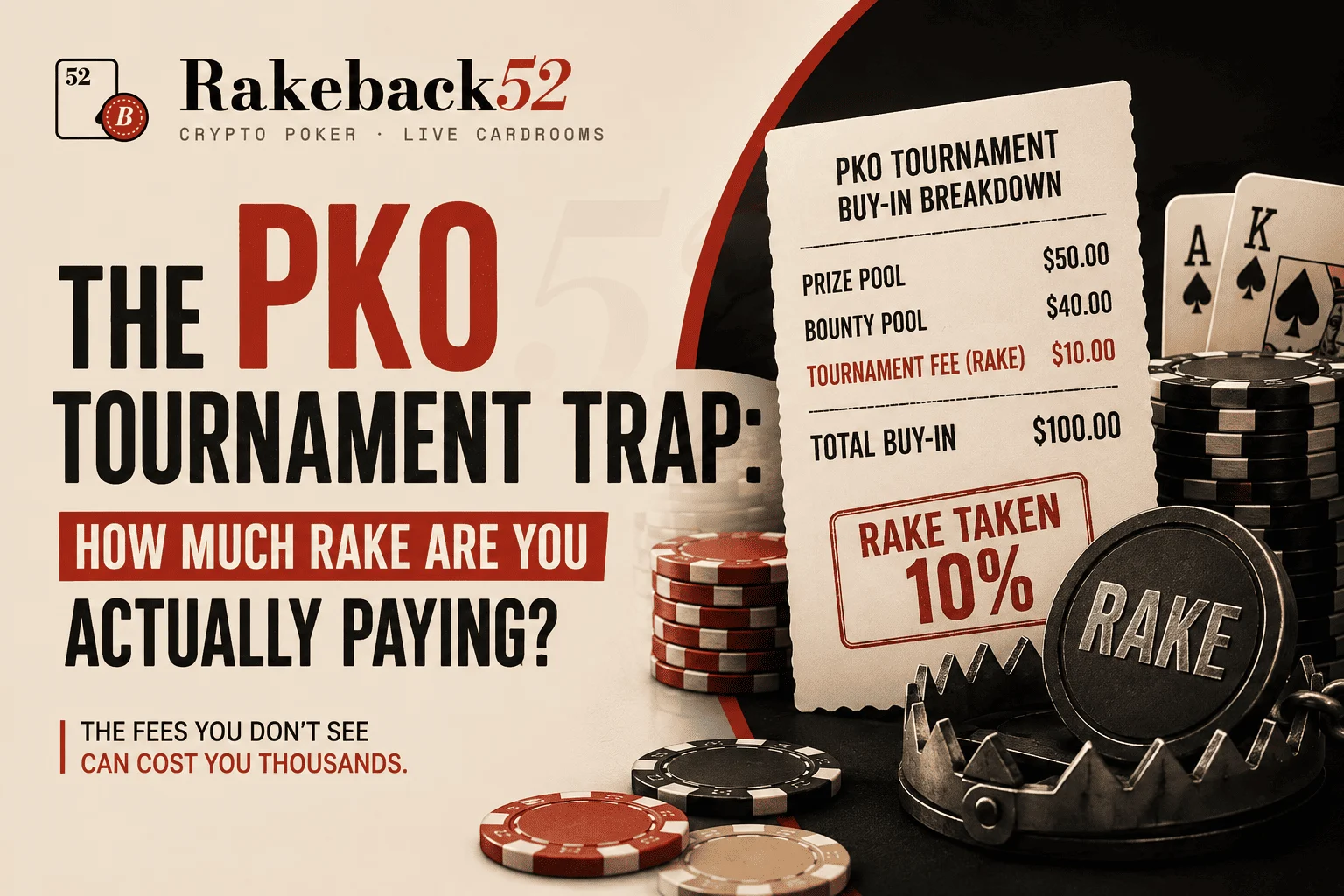
For example, a $55 PKO tournament may be structured as:
$25 goes to the main prize pool.
$25 funds the bounty pool.
$5 is collected as tournament fees.
When you eliminate another player, you instantly receive a portion of their bounty while the remaining amount increases your own bounty value. As the tournament progresses, larger bounties create additional incentives for aggressive play.
This unique structure makes PKO events exciting, but it also makes tournament pricing less transparent because many players focus only on the advertised buy-in rather than analyzing the actual fee percentage.
Understanding PKO Tournament Rake
The PKO tournament rake is the portion of every buy-in that never reaches either the prize pool or the bounty pool. Instead, it is retained by the poker operator as revenue for hosting the tournament.
Unlike cash games where rake is taken from every pot, tournament rake is charged once at registration.
Consider these examples:
Buy-in | Prize Pool | Bounty Pool | Fee |
|---|---|---|---|
$11 | $5 | $5 | $1 |
$22 | $10 | $10 | $2 |
$55 | $25 | $25 | $5 |
$109 | $50 | $50 | $9 |
Many poker sites advertise tournaments simply by displaying the total buy-in. Unless players inspect the breakdown carefully, they may underestimate the true fee percentage.
The higher your playing volume, the more these fees affect your overall return on investment (ROI).
Why Many Players Underestimate the Progressive Knockout Tournament Fee
One reason players misunderstand the Progressive Knockout tournament fee is that the bounty component creates psychological value.
Imagine paying:
$100 to a normal tournament.
$100 to a PKO tournament.
Although both tournaments may charge similar percentages in fees, the PKO format feels more rewarding because players can win immediate bounty prizes throughout the event.
This emotional effect often distracts players from analyzing the actual fee structure.
Over hundreds of tournaments, even a difference of two or three percentage points in fees can represent thousands of dollars in additional costs.
Professional tournament players, therefore, evaluate the following:
Effective tournament fee
Tournament field strength
Blind structure
Guaranteed prize pools
Long-term rakeback opportunities
rather than choosing events based solely on buy-in size.
How Much Rake in PKO Poker?
One of the most common questions players ask is how much rake in PKO poker is actually charged.
The answer depends on the poker site, tournament buy-in, and promotional structure.
Typical fee ranges include the following:
Low stakes: 8–12%
Mid stakes: 6–10%
High stakes: 4–8%
Major series events: often lower due to larger player pools
For example:
An advertised tournament costing $22 may actually consist of:
$10 prize pool
$10 bounty pool
$2 fee
The effective fee equals:
2 ÷ 20 = 10%
Many players simply think they paid $22 without calculating that 10% never entered any prize distribution.
Over 2,000 tournaments, this difference becomes extremely significant.
Why Tournament Fees Matter More Than You Think
Tournament variance is already extremely high.
Players experience:
Long downswings
Large bankroll swings
Delayed returns
High variance due to field size
Adding excessive fees increases the difficulty of remaining profitable.
For example:
Player A pays 6% average fees.
Player B pays 10% average fees.
Both players have identical poker skills.
Over thousands of tournaments, Player A retains substantially more profit simply because less money is lost before the first hand begins.
This is why professional players monitor fees just as carefully as their ROI.
Using a Poker Tournament Rake Calculator
Every serious tournament grinder should occasionally use a poker tournament rake calculator to understand their true long-term costs.
These calculators estimate:
Total fees paid
Average rake percentage
Buy-in distribution
Annual tournament expenses
Net profitability after fees
Suppose you play:
500 tournaments
Average buy-in: $55
Average fee: $5
Your annual fees equal:
500 × $5 = $2,500
Many players are surprised when they realize they spend several thousand dollars every year on tournament fees alone.
Tracking this information helps identify whether moving to another poker site or earning better rakeback would significantly improve overall results.
The Hidden Cost of Bounty Tournament Hidden Fees
Not every cost associated with PKO tournaments appears immediately obvious.
Many players focus only on advertised tournament fees while ignoring other bounty tournament hidden fees that indirectly reduce profitability.
These may include:
Registration Fee Differences
Two tournaments with identical buy-ins may charge different percentages depending on the poker operator.
Smaller Guaranteed Prize Pools
Some operators increase fees while maintaining similar guarantees, reducing player value.
Reduced Promotional Rewards
Sites with weaker loyalty programs effectively increase your long-term cost of playing.
Limited Tournament Selection
Having fewer PKO tournaments available may force players into less favorable structures with higher effective fees.
Understanding these hidden factors helps players evaluate overall value rather than relying solely on headline buy-ins.
How Rake Influences Progressive Knockout Poker Strategy
Tournament fees influence more than just bankroll management—they can even affect progressive knockout poker strategy over the long term.
Higher fees require players to maintain:
Better ROI
More disciplined bankroll management
Improved table selection
Stronger bounty decision-making
Aggressive bounty chasing without considering tournament equity can become even more expensive when fees are already reducing expected returns.
Winning PKO players balance:
Chip EV
Bounty EV
ICM pressure
Final table equity
Tournament fees
instead of focusing exclusively on eliminating opponents.
Comparing PKO Fees Across Poker Rooms
Different poker operators structure tournament pricing differently.
Factors worth comparing include:
Tournament Fee Percentage
Always compare the actual fee instead of the advertised buy-in.
Tournament Traffic
Larger player pools generally create healthier guarantees and more consistent tournament schedules.
Promotional Rewards
Cashback, leaderboard prizes, and loyalty benefits can offset tournament fees significantly.
Software Quality
Reliable software improves the playing experience and reduces technical issues during major tournaments.
Making these comparisons before committing to a poker room can improve long-term profitability.
Reducing Your Effective Tournament Costs
Although tournament fees cannot be avoided entirely, players can reduce their effective costs through careful planning.
Ways to minimise expenses include:
Choose Lower-Fee Tournament Structures
Some operators consistently offer lower fees across comparable buy-ins.
Play During Major Tournament Series
Large festival events often feature reduced fee percentages and better guarantees.
Build Volume During Promotions
Extra leaderboard rewards and cashback promotions reduce overall playing costs.
Maintain Consistent Bankroll Management
Avoid unnecessarily expensive tournaments where fees consume a larger percentage of your bankroll.
Over time, these small improvements compound into substantial savings.
Why Rakeback Matters for Tournament Players
Tournament players often focus entirely on ROI while overlooking the value of ongoing cashback rewards.
Reliable rakeback programmes effectively return part of your tournament fees, reducing your overall cost per event.
If two players have identical poker skills but one consistently earns cashback, the player receiving rewards enjoys a measurable long-term advantage.
This becomes especially important for high-volume grinders who play hundreds of events each month.
Players looking for the best rakeback for poker tournaments should compare affiliate offers, loyalty programmes, promotional campaigns, and recurring cashback opportunities before choosing where to play.
How Rakeback52 Helps Players Maximise Value
Finding profitable PKO tournaments involves more than simply locating the biggest guarantees. Players also need accurate information about tournament fees, promotions, and cashback opportunities.
Rakeback52 helps players compare trusted poker platforms, evaluate ongoing promotions, discover competitive rakeback deals, and identify tournaments that offer better overall value. Instead of focusing only on headline guarantees, the platform encourages players to consider the complete cost of playing, including tournament fees and long-term rewards.
Whether you are a casual player entering weekend events or a dedicated grinder playing daily schedules, using Rakeback52 to compare available offers can significantly improve your long-term expected value.
If you enjoy competing in online poker tournaments, reviewing available promotions before registering can help reduce your effective costs over time.
Players interested in alternative payment options can also explore trusted crypto poker rooms that combine modern payment methods with competitive tournament schedules and exclusive cashback opportunities.
Common Mistakes Players Make When Evaluating PKO Tournament Fees
Ignoring the Buy-In Breakdown
Many players never examine how much of their entry goes toward the prize pool, bounty pool, and tournament fee.
Chasing Large Guarantees Only
A tournament with a massive guarantee is not always the most profitable if the fee percentage is significantly higher.
Overlooking Long-Term Costs
Small fees become substantial expenses when multiplied across hundreds or thousands of entries.
Ignoring Cashback Opportunities
Failing to claim rakeback or promotional rewards effectively increases your tournament costs.
Comparing Only Buy-In Sizes
Two tournaments with identical advertised prices may have very different effective fee percentages.
Conclusion
Progressive Knockout tournaments remain one of the most entertaining and strategically complex formats in modern online poker. However, understanding the PKO tournament rake is essential for anyone hoping to build long-term profitability. The Progressive Knockout tournament fee may appear small on a single buy-in, but across months or years of regular play it represents a significant expense that directly affects your ROI.
Calculating your effective tournament costs, using a poker tournament rake calculator, comparing fee structures, avoiding hidden charges, and securing quality rakeback opportunities are all part of becoming a smarter tournament player. Platforms like Rakeback52 make it easier to compare trusted poker rooms, discover valuable promotions, and reduce the overall cost of playing PKO tournaments without compromising on tournament quality.